Here is a question that sounds simple but gets complicated fast: why do people live where they do?
The standard answer — people cluster near water, fertile land, and mild climates — is true but incomplete. It doesn’t explain why the North China Plain supports one of the densest agricultural populations on Earth while the Amazon Basin, also wet and warm, supports almost no one. It doesn’t explain why the Great Plains produce massive grain surpluses but not massive cities. And it doesn’t explain why cold, dry Inner Mongolia is covered in pasture rather than crops or people.
The new Bivariate Climate layer on geteach.com makes the underlying logic visible. By blending mean annual temperature and total annual precipitation into a single 2D color grid, it reveals the climate matrix that sets the terms for everything else — which land gets farmed, which land gets grazed, and where humans ultimately concentrate. Pair it with the Cropland, Pastureland, and Population Density layers and you have a four-map inquiry sequence that runs from physical geography to human geography in a single class period.
This lesson works for AP Human Geography Units 1, 2, and 5, NGSS MS-ESS2-6 and HS-ESS2-4, and Geography for Life Standards 7, 8, 9, and 15.
What the Bivariate Climate Layer Shows
Most climate maps show one variable at a time — temperature or precipitation, but not both simultaneously. The Bivariate Climate layer uses a 2D color scale to show both at once, for the 20-year period from 2004 to 2023.
The logic of the color grid is straightforward:
- Temperature runs on one axis — from cold blues to warm reds
- Precipitation runs on the other — from dry yellows to wet greens
- Where the two intersect produces the blended color that represents that location’s full climate character
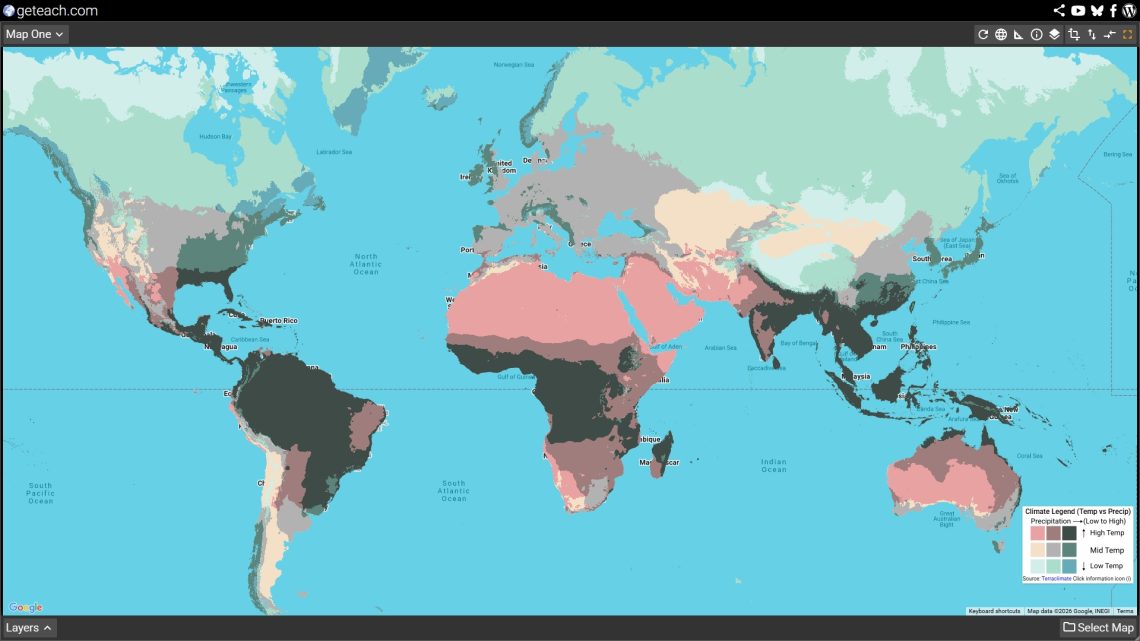
The result is a map that encodes the climate regimes that define Earth’s biomes in a single visual layer. Hot and wet is deep teal-green — tropical rainforest. Hot and dry is amber-red — tropical desert. Cold and wet is blue-green — boreal forest and tundra. Cold and dry is pale blue-grey — polar desert. The color a location wears tells you almost everything you need to know about what grows there, who can live there, and how many of them.
Load it on Map 1 at geteach.com: Select Map → Physical Geography → Climate → Bivariate Climate. Leave it there for the whole lesson.
The Lesson: Four Maps, One Argument
The lesson runs through four layers in sequence. Each layer adds one piece to the argument. By the end, students have built a geographic explanation for global population distribution from the ground up — starting with climate and ending with human settlement.
Setup: Use geteach.com’s dual-canvas interface throughout. Keep Bivariate Climate on Map 1 the entire time. Swap the comparison layer on Map 2 as the lesson progresses.
Map 1 — Bivariate Climate (Map 1, stays all lesson)
Load Bivariate Climate Layer: Select Map → Physical Geography → Climate → Bivariate Climate
Give students two or three minutes to read the map before saying anything. Then ask:
“What are the largest color zones on this map? What do you think those colors mean?”
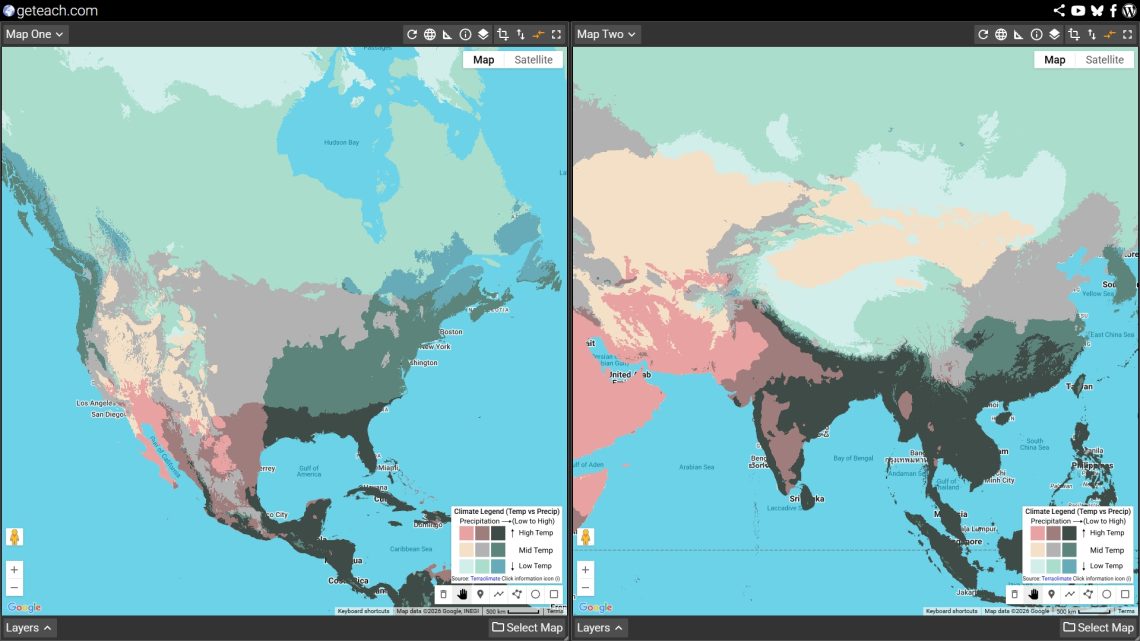
After students describe what they see, introduce the bivariate logic: one axis is temperature, one is precipitation, and the color is the intersection of both. Walk through a few anchor examples together:
- The Congo Basin and Southeast Asia — deep blue-green: hot and very wet. This is tropical rainforest climate.
- The Sahara and Arabian Peninsula — deep red-amber: hot and very dry. This is tropical and subtropical desert.
- The Canadian Shield and Siberia — cool blue-green: cold and moderately wet. Boreal forest (taiga) climate.
- The American Great Plains and Central Asian steppe — warm tan-gold: temperate but dry. Grassland and semi-arid climate.
- Western Europe and the US Pacific Northwest — warm and moderately wet: the mid-latitude sweet spot where most of the world’s agricultural surplus is produced.
Key question before moving on:
“If you were going to predict where on Earth humans grow most of their food, which colors would you look for? Which colors would you rule out immediately?”
Have students write or discuss their predictions. Then load Map 2 to check.
Map 2 — Cropland (Map 2)
Load Cropland Layer: Select Map → Human Geography → Geography Land → Cropland
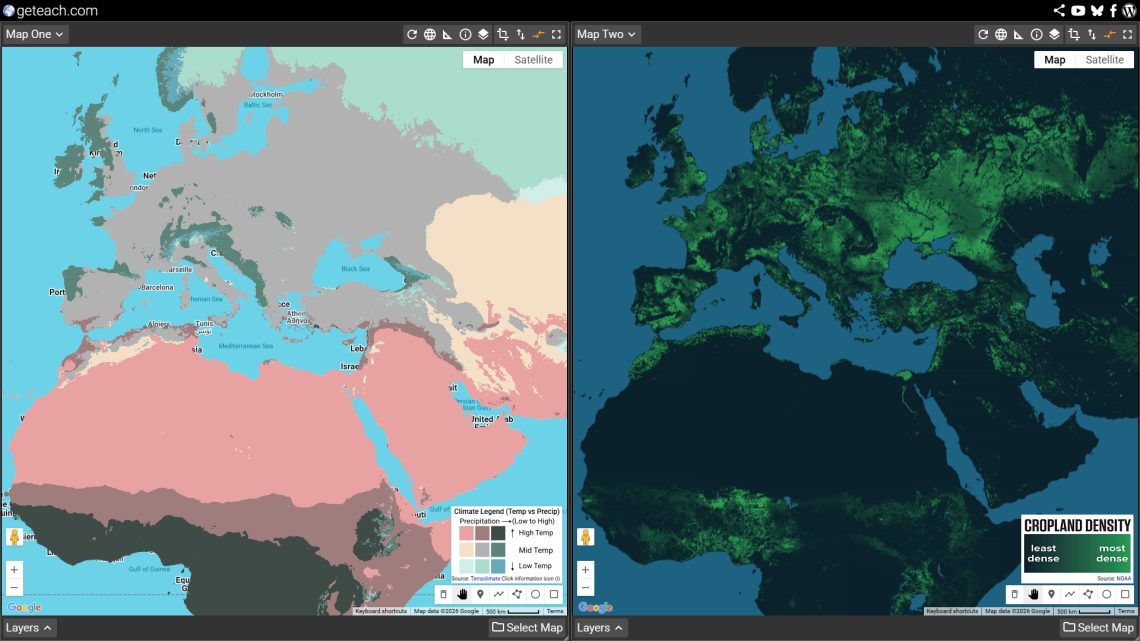
Now students compare their climate predictions against actual global cropland distribution.
“Does the cropland map confirm your predictions? Where does it surprise you?”
The major patterns that emerge from this comparison:
- The temperate band matches almost exactly. The Northern Hemisphere’s great agricultural zones — the North China Plain, the European Plain, the US Corn Belt, the Canadian Prairies — all sit in the warm-to-mild, moderately wet bivariate colors. Not the wettest, not the driest. The middle.
- Hot and wet ⁄ farmland. The tropical rainforest zones (Congo, Amazon, Southeast Asian interior) show surprisingly little cropland relative to their rainfall. The soils beneath tropical forest are often thin and nutrient-poor — the nutrients are locked in the biomass, not the ground. When forest is cleared, productivity drops quickly without heavy inputs.
- Hot and dry ⁄ farmland, with exceptions. Deserts are blank on the cropland map — except in the Nile Valley, the Indus Valley, and California’s Central Valley, where river systems or irrigation allow agriculture to bypass the climate constraint entirely. These are worth pausing on: they are places where humans broke the climate-agriculture relationship through water engineering.
- The monsoon exception. Parts of South and Southeast Asia, including the Indo-Gangetic Plain, show significant cropland in climates that look too hot and wet on the bivariate map. Intensive agriculture (particularly wet-rice cultivation) is adapted to flooded, monsoon conditions that would destroy other crops — a cultural and agricultural technology that unlocked immense food production in climate zones most other farming systems could not use.
Discussion question:
“Environmental Determinism argues that the physical environment dictates human activity. Based on the cropland map, where does this theory seem to hold true, and where do humans demonstrate Possibilism?”
Map 3 — Pastureland (Map 2)
Load Pastureland Layer: Select Map → Human Geography → Geography Land → Pastureland
Swap Cropland for Pastureland. The shift is immediate and striking.
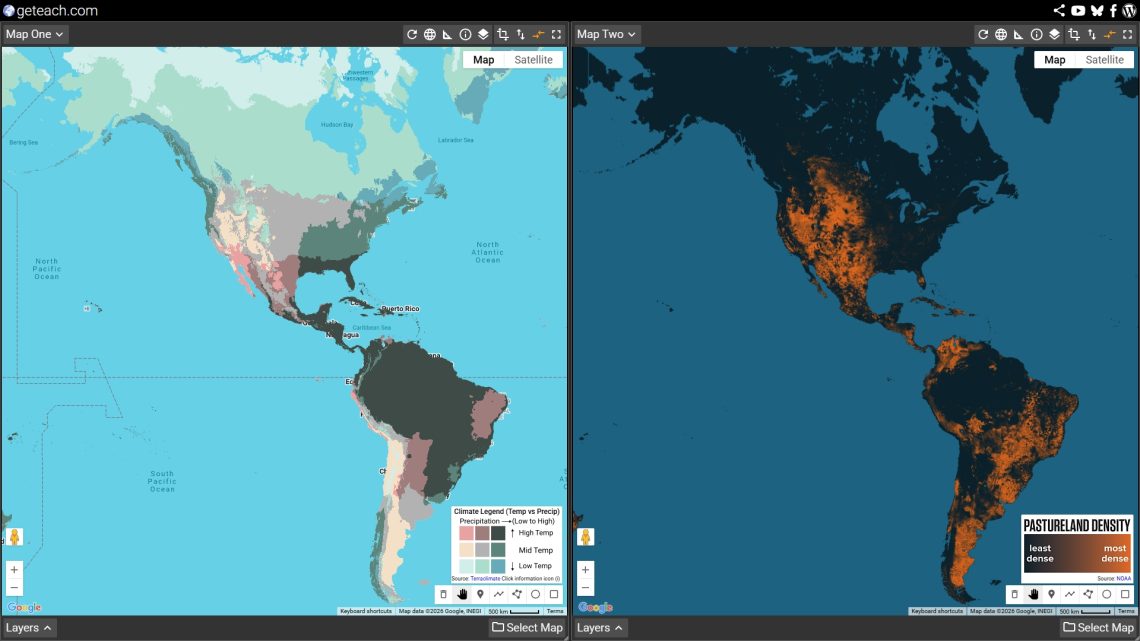
“What do you notice about where pastureland is compared to where cropland was? What bivariate colors does pastureland occupy that cropland didn’t?”
Pastureland is the land use that fills the gaps cropland cannot:
- The semi-arid and dry belts. The Sahel, the Central Asian steppe, the Argentine Pampas, the Australian interior, the American Great Basin — all too dry for reliable crop agriculture, but grasses grow, and grass can be converted to food through livestock. Pastoralism as a land use is a climate adaptation strategy.
- The cold northern margins. Mongolia, northern Scandinavia, highland Central Asia — too cold and too short a growing season for crops, but reindeer, yak, and sheep can graze on what grows. Nomadic and semi-nomadic pastoralism is a rational response to cold-dry bivariate zones that would show up as cool blue-grey on the bivariate map.
- The tropical savannas. Sub-Saharan Africa and northern Australia show heavy pasture in warm-but-seasonally-dry bivariate zones. The wet season produces grass; the dry season forces movement or hay storage. The long-distance cattle drives and seasonal transhumance that define these regions are written into the climate.
- Where pastureland and cropland overlap. Some of the most productive agricultural regions — parts of the US Great Plains, the South American Pampas, parts of Europe — show both. Mixed farming systems rotate crops and livestock on the same land, a strategy that reflects moderate climates where both are viable.
Key insight to draw out:
“If cropland follows the moderate, reliable climates, pastureland follows the marginal ones — too dry, too cold, or too seasonal for crops but not empty. Together, cropland and pastureland show us how humans have colonized almost every climate zone on Earth by matching their food production system to what the climate allows.”
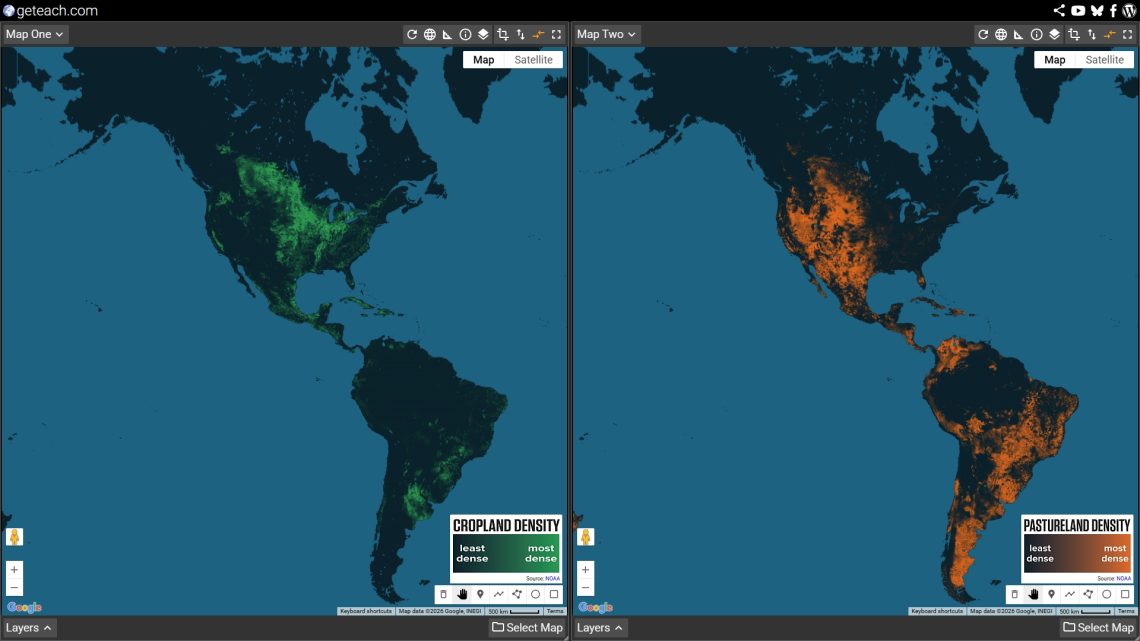
Optional: Change Map 1 to the “Cropland” layer and compare Cropland (Map 1) with “Pastureland” (Map 2). This side-by-side view highlights the spatial division between intensive and extensive land-use patterns. Once you have completed your comparison, change Map 1 back to the “Bivariate Climate” map layer to anchor the final step of the lesson.
Map 4 — Population Density (Map 2)
Load: Select Map → Human Geography → Population Density → Population Density 2025
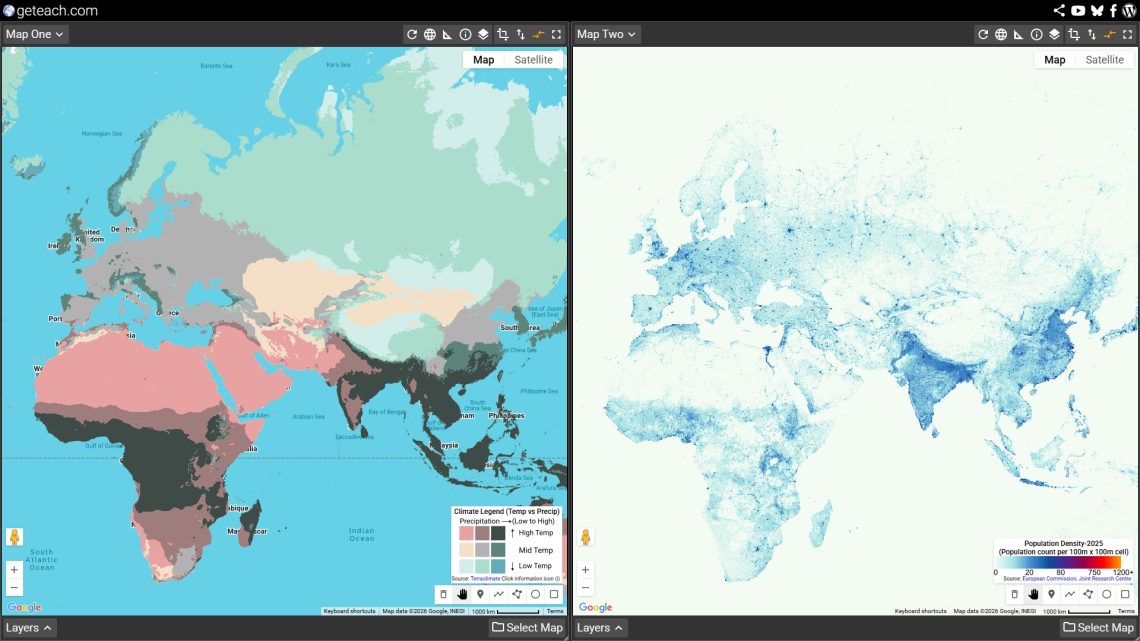
“We’ve now seen where climate allows farming and where it allows grazing. Where do people actually live? Does population density follow cropland, pastureland, or something else entirely?”
The comparison between bivariate climate and population density 2025 produces the lesson’s most important observations:
- Population density closely tracks cropland, not pastureland. The dense population bands of East Asia (North China Plain) and Europe sit squarely on the same temperate-to-subtropical, moderately-wet bivariate colors as the major cropland zones. High agricultural productivity is the engine that supports dense human settlement.
- The great pastoral regions are sparsely populated. Mongolia, the Sahel, the Australian interior, and Central Asia — enormous pastoral zones — support very low population densities. Because these extensive food systems produce fewer calories per square kilometer than grain agriculture, they support lower arithmetic densities.
- The tropical rainforest disconnect. The hot-wet zones that are neither major cropland nor major pastureland (like the Amazon and Congo Basins) are also not densely populated. Despite being climatically energetic, these regions have low carrying capacities for human settlement without massive external inputs.
- The coastal and river exception. Where the bivariate map shows climatically marginal zones (deserts), population density often spikes along rivers — places where access to water and trade routes override the climate signal. The Nile, Indus, and Yellow River valleys show up as “population islands” in challenging climates, illustrating Possibilism.
- The monsoon mega-cluster. The single densest population zone on Earth — the arc from the Ganges Plain through South China to the Yangtze Valley — sits in a warm, monsoon-wet bivariate zone. Here, intensive agriculture unlocked climate potential that other farming systems could not reach. Over three billion people live within this specific bivariate color band.
Synthesis question:
“Based on all four maps, write one or two sentences that explain the geographic logic connecting climate to land use to population density. Where does the logic hold? Where does it break down, and what human factors explain the exceptions?”
Assessment Options
Quick Check (5 minutes)
Display the bivariate legend and three bivariate color swatches. Ask students to predict: (1) whether this climate zone is likely to support cropland, pastureland, or neither; and (2) whether it is likely to have a high or low population density. Justify each answer using the lesson’s logic.
Written Response (15–20 minutes)
Choose one of the following locations. Using the four maps from today’s lesson, explain why this location has the population density it does. Your explanation should begin with climate, move through land use, and end with population. Identify at least one place where the climate-to-population logic holds and one exception within the same region.
- The Ganges Plain (India)
- The Sahel (West Africa)
- The Great Plains (United States)
- The Mekong Delta (Southeast Asia)
- Patagonia (Argentina)
Map Annotation (Homework or in-class extension)
Take a screenshot of your two-canvas comparison from geteach.com. Using an annotation tool, identify the following:
- Three locations where the bivariate climate directly explains the land use and population density patterns.
- One location where human intervention (such as irrigation, technology, or trade) overrides the climate constraint to support higher density or agriculture.
Extensions and Connections
Connect to the Human Climate Niche
After completing this lesson, load the Human Climate Niche — 2020 and Human Climate Niche — 2070 layers from the Climate mapset. The niche maps show which bivariate zones humans have preferred for 6,000 years — and which zones are projected to fall outside that range by 2070 under high-emissions scenarios. Ask: if the climate-to-population logic holds, what happens to population distribution when the bivariate color of a place changes?
Add the Vegetation Index
Load any month of the Vegetation Index (NDVI) alongside the Bivariate Climate layer. The NDVI shows living plant cover — the biological output of the climate the bivariate map measures. July is particularly useful: it shows Northern Hemisphere peak greenness and reveals how closely photosynthetic productivity tracks the bivariate color pattern.
Climate Graph Challenge
After students understand the bivariate logic, use the Climograph Challenge game (accessible from the main platform) to test whether they can identify a location’s bivariate zone from its temperature curve and precipitation bars alone. A student who can read a climograph and place a pin in the right bivariate zone is demonstrating genuine climate-space reasoning.
Food vs. Feed
Swap Cropland for Food vs. Feed (Geography Land mapset). This layer shows what share of cropland production goes to direct human consumption versus animal feed. The comparison with bivariate climate adds a second dimension to the land use argument: in the high-productivity temperate zones, much of the agricultural surplus goes not to feeding people directly but to feeding livestock — a caloric inefficiency that connects back to the population density patterns students observed.
Curriculum Alignment
| Framework | Standards |
|---|---|
| AP Human Geography | Unit 1 (1.4 — physical geography and human activity); Unit 2 (2.3, 2.4 — population distribution and density); Unit 5 (5.1, 5.2 — agricultural origins and land use; 5.6, 5.7 — food production systems) |
| NGSS | MS-ESS2-5; MS-ESS2-6 (weather and climate systems); HS-ESS2-4 (climate variability); HS-ESS3-1 (natural resources and human systems); HS-ESS3-3 (human impacts on Earth systems) |
| Geography for Life | Standard 7 (physical processes shaping Earth’s surface); Standard 8 (ecosystems and biomes); Standard 9 (characteristics and distribution of human populations); Standard 15 (how physical systems affect human systems); Standard 16 (resources and their use) |
Layers Used in This Lesson
All layers are free, require no login, and are accessible at geteach.com.
| Layer | Mapset | Role in Lesson |
|---|---|---|
| Bivariate Climate | Climate | Anchor layer — stays on Map 1 throughout. Sets the climate context for every other comparison. |
| Cropland | Geography Land | Map 2 — tests the prediction that moderate, reliable climates drive agriculture. |
| Pastureland | Geography Land | Map 3 — shows how marginal climates (too dry, too cold, too seasonal) are colonized through livestock rather than crops. |
| Population Density 2025 | Population Density | Map 4 — the human outcome. Tests whether climate-driven land use explains where people actually live. |
Use the share icon on geteach.com to capture any two-canvas configuration as a permanent link you can distribute to students or embed in a slide deck. No account required.